 Moodily
 project · Meta Global AI Developer Hackathon 2026 (Indie track)
Seat Desk — a front desk that answers in Hindi and English, and refuses to guess.
A small study library's front desk answers the same questions all day: क्या कल दोपहर सीट खाली है? What is the monthly fee? When do you open? Seat Desk answers them in Hindi or English. The demo runs on synthetic data modelled on Rasra Library & Study Point.
Status: runs locally on synthetic data. One genuine live Muse Spark call is on record (3 November 2026). Not a hosted public app yet — see "Run it yourself" below.
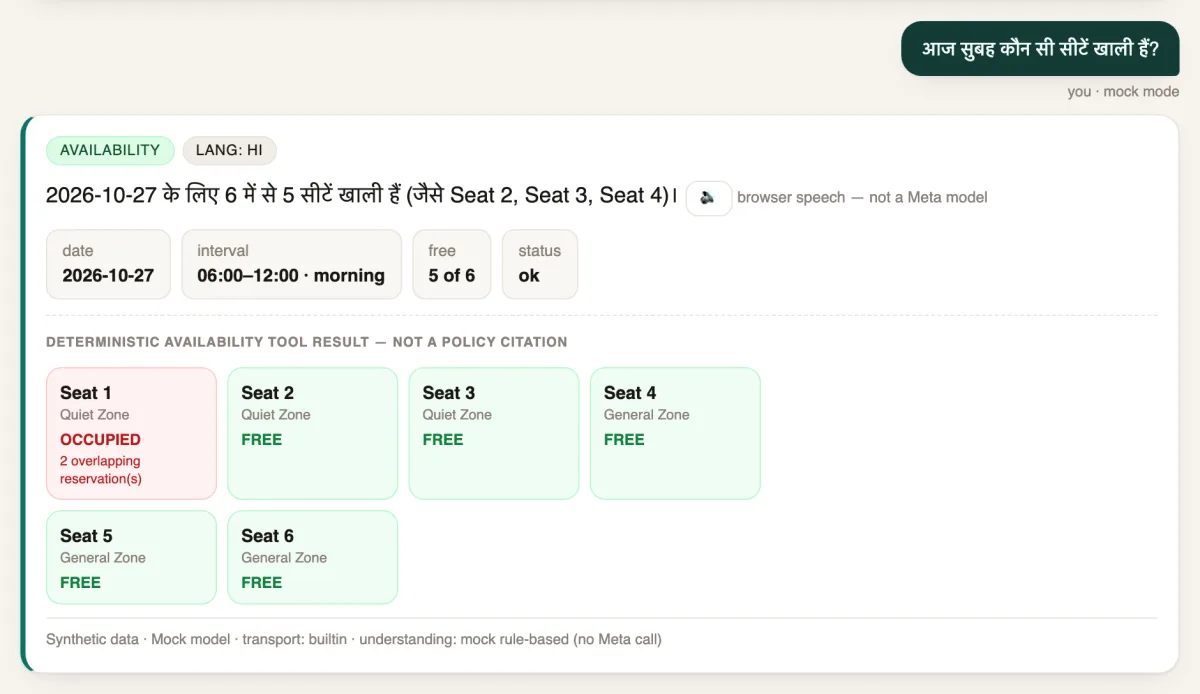
The desk answering a seat question
The design rule: the model understands, the code decides
AI assistants fail front desks when they invent facts. Seat Desk splits the job: the model reads the question, and code supplies every fact.
🧠 Understanding
Meta's Muse Spark 1.3 turns a sentence — "28 अक्टूबर को दोपहर में कौन सी सीटें खाली हैं?" — into a validated, structured query (date, time slot, intent). It does not write the answer.
🎙 Spoken Hindi
Muse Voice Transcribe 1.0 turns a recording into a transcript, which is used only after the speaker confirms or corrects it. Built into the local desk; a successful live transcription is not yet on record.
🧮 Facts
Seat availability, hours and fees come from deterministic code and an approved knowledge pack (synthetic in the demo). A policy answer must cite an approved entry, or it goes to a person.
🤝 Honest limits
Refunds, bookings and anything outside the approved pack produce a handoff summary for a person, marked not sent. Nothing is booked or messaged automatically.
Live-tested, built, and planned
✅ Live-tested with Meta's API
- One Muse Spark 1.3 call (3 November 2026): a typed Hindi seat question became a validated query, and the code-computed answer passed every acceptance check.
- Evidence is in the repository:
evidence/live_run.json.
🧪 Built and tested offline
169 automated tests, mock model, synthetic data.
- Seat availability, including overlapping records
- Policy answers that must cite an approved entry
- Clarifying questions and multi-turn follow-ups
- Human-handoff summary, never sent
- Voice recording with transcript confirmation
- Local web desk with per-visitor sessions and app-level spending counters
🔜 Planned, not built
- A hosted public demo
- Connection to a real library's records
- Booking or message delivery (out of scope by design)
- Spotting conflicting figures inside one question
- Wider live evaluation (one live call so far)
- Approved packs for other local businesses — the broader Moodily direction
Three-minute demonstration
The demonstration video will be linked here once it is published with the hackathon submission (due 4 November 2026). Until then, the repository's README shows how to run the core typed workflow offline, without an API key.
Architecture in one paragraph
Voice or text enters a local web desk (plain Python, no frameworks). Audio goes to Muse Voice Transcribe over Meta Model API; the transcript must be confirmed by the speaker. Confirmed text goes to Muse Spark 1.3 with a strict JSON schema, minimal reasoning effort, bounded output tokens, zero retries and one outstanding request. The typed, validated extraction (language, intent, date, interval, slot, seat) drives a deterministic availability engine and an approved-policy retrieval layer with citation checks, and code writes the answer. In the test suite and the one-shot live harness, an independent checker re-derives the expected interval, counts and free seats from the raw fixtures, so a wrong count, interval or seat set is recorded as a failure. Every response is labelled with its provenance: synthetic data, live or mock understanding, transport, and token usage in live mode.
Demonstration data is historical and synthetic (fixture clock 27 October 2026 IST). No real member records exist anywhere in the project, and the real library's membership system is not connected.
Run it yourself
Offline and free in mock mode; live mode needs your own Meta Model API key.
Setup instructions in the README →
Built by Saurabh Kumar (Moodily) during the hackathon building period, 27 October – 4 November 2026. Open source under the MIT licence.